For decades, glaucoma management has followed a conservative path: monitoring, medicating, and hoping for patient adherence. Yet despite best intentions, compliance issues and general fatigue with glaucoma drop therapy often undermine outcomes.
A growing number of clinicians are now embracing a new philosophy – interventional glaucoma — that emphasizes timely procedural care, earlier intervention, and shared responsibility across the care team.
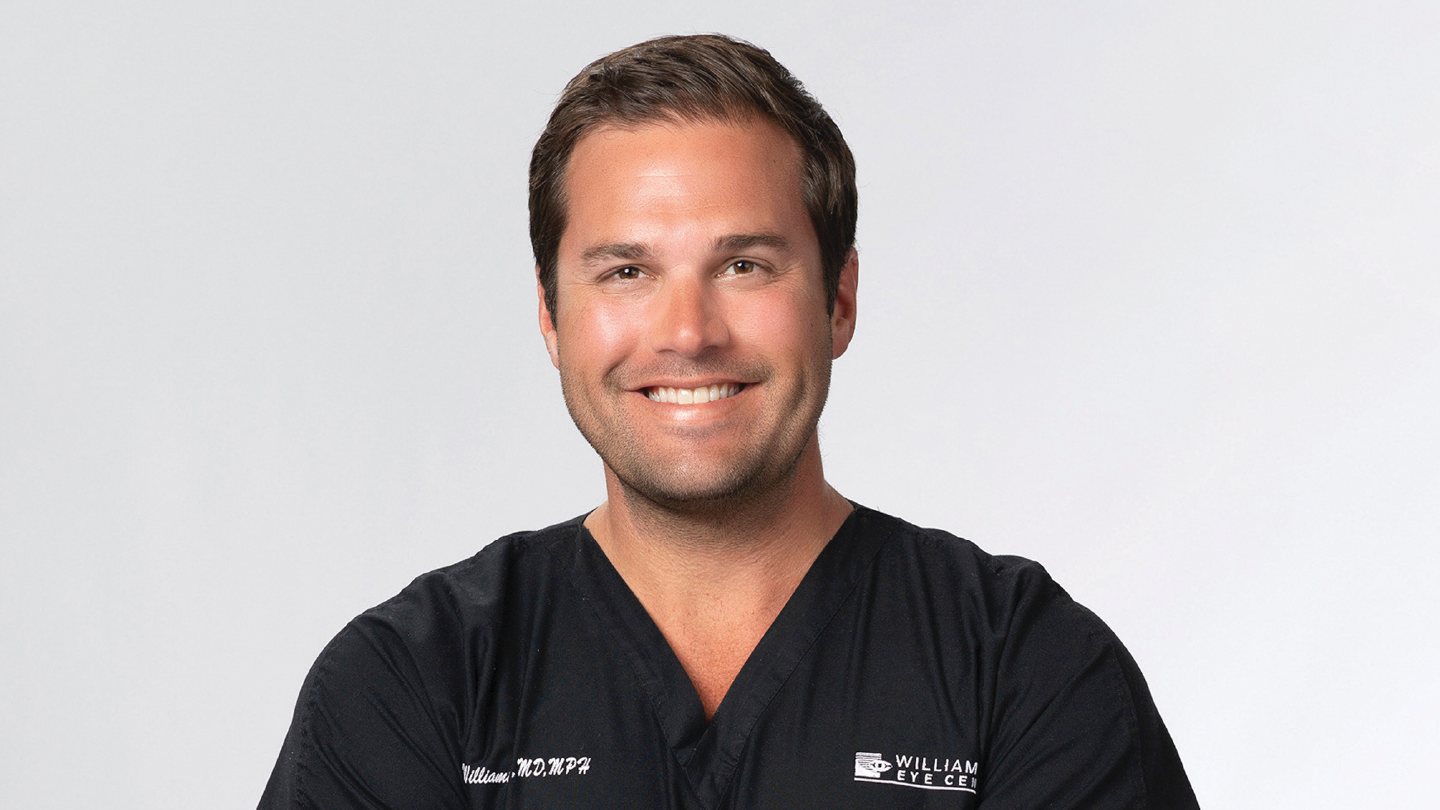
In this article, Dr. Blake K. Williamson (pictured right) – President and Managing Partner of Williamson Eye Center, Baton Rouge, LA – and Charles H. Williamson Jr. (pictured below), Administrator of Williamson Eye Center and co-owner of Williamson Management, LLC and Williamson Eyewear – discuss how this shift is transforming their practice, from the way they define success to how they engage colleagues and empower patients.
Defining interventional glaucoma

At its core, interventional glaucoma is not about any single technology or procedure – it’s about being “proactive instead of reactive,” notes Blake. The shift to an interventional approach is about “actually doing something for patients,” he says. “Like many practices, we were doing our best before, but we could have been doing more to identify opportunities for procedural intervention where patients would undoubtedly have benefited.” He adds, “Since shifting to a more procedural-based approach, we’re seeing patients who rely less and less on eye drops and have more trust in procedural intervention.”
It also means that the practice surgeons strive to get to know their patients – and their problems – better, adds Charles; this allows the surgeons to intervene and take care of their glaucoma needs earlier.
And ultimately, such an approach is in line with broader healthcare trends. As Blake points out, “Where else in medicine would we sit around and wait for people to get worse?”
Clear treatment protocols
A cornerstone of interventional care is establishing a clear, consistent framework that all team members can follow. Blake explains that formalizing preferred treatment protocols has brought clarity to his practice colleagues and collaborators, particularly the optometrists that handle most of the primary care.
“They need to know what to refer and when to refer,” he says.
Developing preferred practice guidelines – and reviewing them in detail across the entire team – created that shared understanding.
“I think this has also helped our surgeons develop their own identity with regard to interventional procedures,” explains Charles. “Establishing an order of treatment protocols – in terms of go-to treatments for any particular stage of glaucoma treatment – has been a great consensus builder amongst our surgeons.”
Once protocols were drafted, Blake and Charles ensured buy-in by making the process collaborative. Instead of issuing top-down directives, they invited their entire team – from technicians to optometrists – to co-author the guidelines.
“You ask them to create it with you; it is as much their protocol,” says Blake. This inclusivity is key – by involving everyone in shaping the algorithm, the final product became something the team owned rather than something they were told to follow. The result, Blake adds, was a stronger commitment to consistent care.
Charles echoes that point: “Developing a consensus with your providers makes them take ownership in the protocol process.” The approach not only builds compliance, but also strengthens collaboration between providers and surgeons.
Selecting the right interventional option
With an expanding array of pharmaceutical and surgical tools – from procedural pharmaceuticals like iDose TR (travoprost intracameral implant) 75 mcg and Durysta®, selective laser trabeculoplasty (SLT) and micro invasive glaucoma surgery (MIGS) – deciding which option suits which patient can be difficult.
The best procedure is the one each surgeon performs most effectively, Blake explains. Outcomes, comfort level, and experience matter more than any one product’s specifications. “If you find that you are having more success, fewer complications, or better efficacy with procedure A, then the best treatment is procedure A,” he says.
In general, he adds, SLT or procedural pharmaceuticals serve as a sensible starting point, often preferred over topical medication for its efficacy and simplicity. From there, many clinicians move to procedural pharmaceuticals and then procedures that preserve the trabecular outflow pathway – such as dilation or stenting – before progressing to more ablative techniques like goniotomy.
The integration of procedural pharmaceuticals is surgeon- and clinic-dependent, explains Blake. A patient who responded well to latanoprost but disliked its ocular-surface side effects, for example, might transition to iDose TR, and then later consider a stenting procedure if necessary.
“That’s a loose algorithm,” Blake adds, “but everybody’s going to be a little different.”
Embracing new diagnostic technologies
The future of interventional glaucoma is not limited to the surgical suite. Blake and Charles see tremendous value in new diagnostic and monitoring tools, from homebased IOP sensors to portable OCT and AI-driven screening. Blake emphasizes that the ability to gather serial, real-world data will allow for earlier detection of disease progression. Too often, he says, patients are seen at best every six months, and more often than not a visual field isn’t performed, during which time significant nerve fiber changes may occur. “If someone can actually do this at home, they’re much more likely to follow through,” he explains. Just as patients check blood pressure or glucose at home, he envisions glaucoma patients tracking IOP and visual field changes independently.
Charles sees this as a vital shift toward shared responsibility: “Anything that drives awareness to the patient relative to their glaucoma condition is a good thing.” Home monitoring, he says, helps patients become more engaged partners in their care and “provides them with a pathway to be more responsible for their overall glaucoma health.”
Measuring success and redefining outcomes
When evaluating outcomes, Blake stresses that success in interventional glaucoma must be defined differently from traditional surgery. “If you have delayed the progression of nerve damage or visual field loss, then that was a success,” he says. Even if additional interventions are required later, that doesn’t constitute failure. Success can mean buying time, minimizing side effects, or avoiding more invasive surgery. “We’re just trying to prevent the progression of glaucoma and avoid procedures with less attractive side-effect profiles,” he summarizes.
The next frontier
As he looks to the future, Blake predicts that procedures with “the least amount of side effects and the least potential for complication” will dominate. Many surgeons, he notes, remain hesitant to operate solely for glaucoma management. “I believe the future of interventional glaucoma is utilizing the micro invasive, safe and effective products we have today to deliver a robust IOPlowering response,” he says. “This will give the average surgeon – in the US and around the world – the confidence to take someone to the OR just for this procedure, and not for a combination cataract and glaucoma procedure.” At the same time, Blake expects procedural pharmaceuticals to evolve rapidly, delivering sustained drug delivery precisely where it’s needed. He also sees a future where at-home diagnostics play a direct role in triggering interventions. “That day might come when a patient says, ‘My sensor went off – it’s saying my RNFL has had some damage. What are we going to do?’”
Charles agrees, observing that “innovation begets innovation.” As new solutions emerge, they spur improved iterations and provide surgeons with an ever-expanding toolkit to tailor care. “That’s going to continue to deliver tools to the surgeons that they can tailor for their patients,” he says, creating an environment of continuous progress.
Conclusion
Interventional glaucoma represents more than a set of new procedures – it is a philosophical shift toward active, collaborative, and procedure based earlier care. By building clear protocols, engaging every member of the care team, embracing innovation, and empowering patients to participate in their own monitoring, practices are redefining what successful glaucoma management looks like.
IMPORTANT SAFETY INFORMATION
Dosage and Administration
For ophthalmic intracameral administration. The intracameral administration should be carried out under standard aseptic conditions.
Contraindications
iDose TR is contraindicated in patients with active or suspected ocular or periocular infections, patients with corneal endothelial cell dystrophy (e.g., Fuch’s Dystrophy, corneal guttatae), patients with prior corneal transplantation, or endothelial cell transplants (e.g., Descemet’s Stripping Automated Endothelial Keratoplasty [DSAEK]), patients with hypersensitivity to travoprost or to any other components of the product.
Warnings and Precautions
iDose TR should be used with caution in patients with narrow angles or other angle abnormalities. Monitor patients routinely to confirm the location of the iDose TR at the site of administration. Increased pigmentation of the iris can occur. Iris pigmentation is likely to be permanent.
Adverse Reactions
In controlled studies, the most common ocular adverse reactions reported in 2% to 6% of patients were increases in intraocular pressure, iritis, dry eye, visual field defects, eye pain, ocular hyperaemia, and reduced visual acuity.
Indications and Usage
iDose TR (travoprost intracameral implant) is indicated for the reduction of intraocular pressure (IOP) in patients with open-angle glaucoma (OAG) or ocular hypertension (OHT).
Please see Prescribing Information at
https://www.idosetrhcp.com/wp-content/ uploads/2024/01/iDose-TR-Prescribing- Information.pdf
You are encouraged to report all side effects to the FDA. Visit www.fda.gov/medwatch, or call 1-800-FDA-1088. You may also call Glaukos at 1-888-404-1644.
Blake Williamson and Chuck Williamson were compensated by Glaukos for their contribution to this article.
All other trademarks are property of their respective owners.
PM-US-3348