When Haag-Streit introduced its first slit lamp in 1933, the company was already decades into its legacy as a precision Swiss manufacturer. Founded more than 165 years ago, Haag-Streit built its reputation from its very beginnings on innovation and engineering excellence.
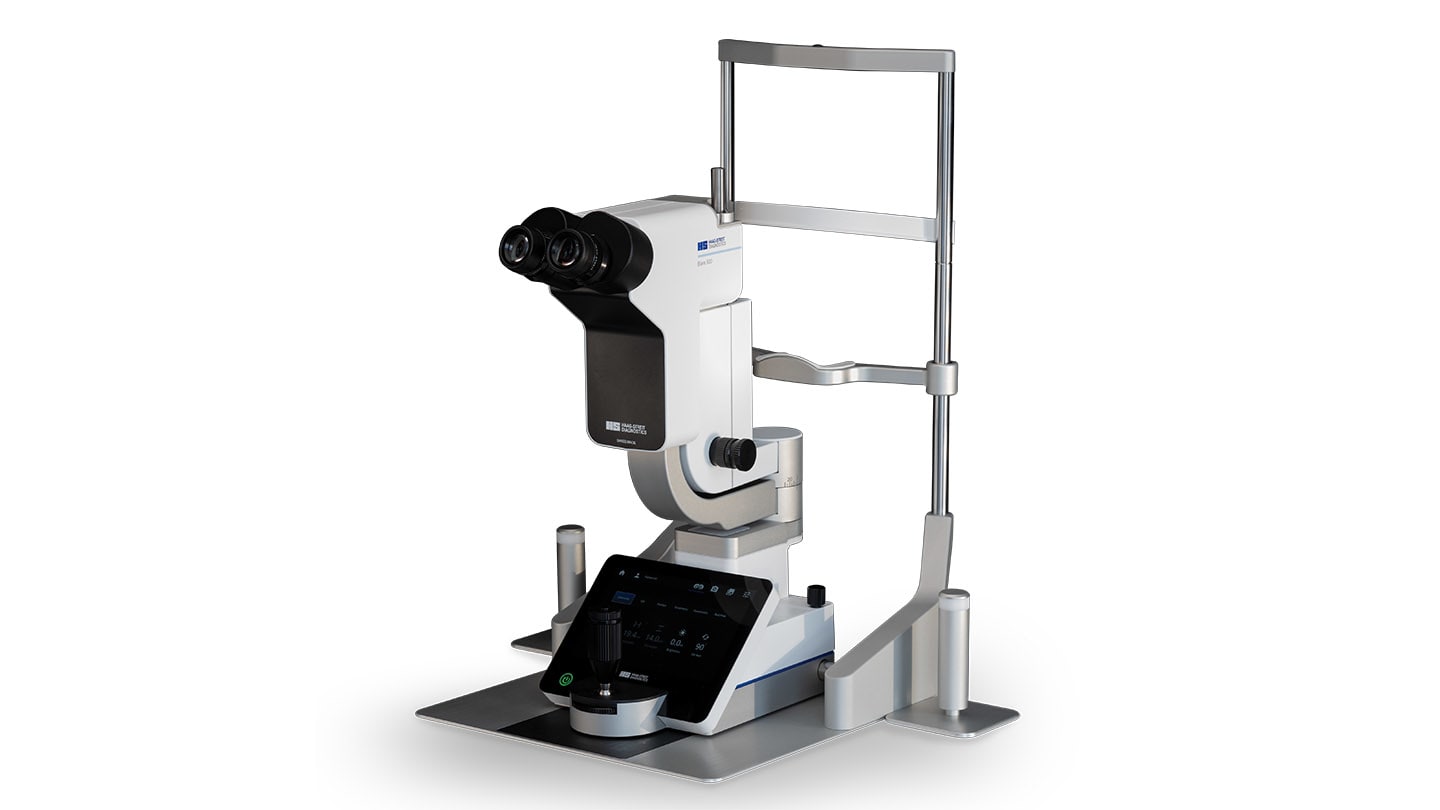
In September 2025, the company launched their latest slit lamp - the Elara 900, further advancing the gold-standard optics established by the BQ 900 in 1986. Billed as a “slit lamp for the 21st century,” Elara 900 is designed for ambitious eye care professionals seeking superior visualization, streamlined workflow, and enhanced comfort during examinations.
But how does this innovation perform in real clinical practice?
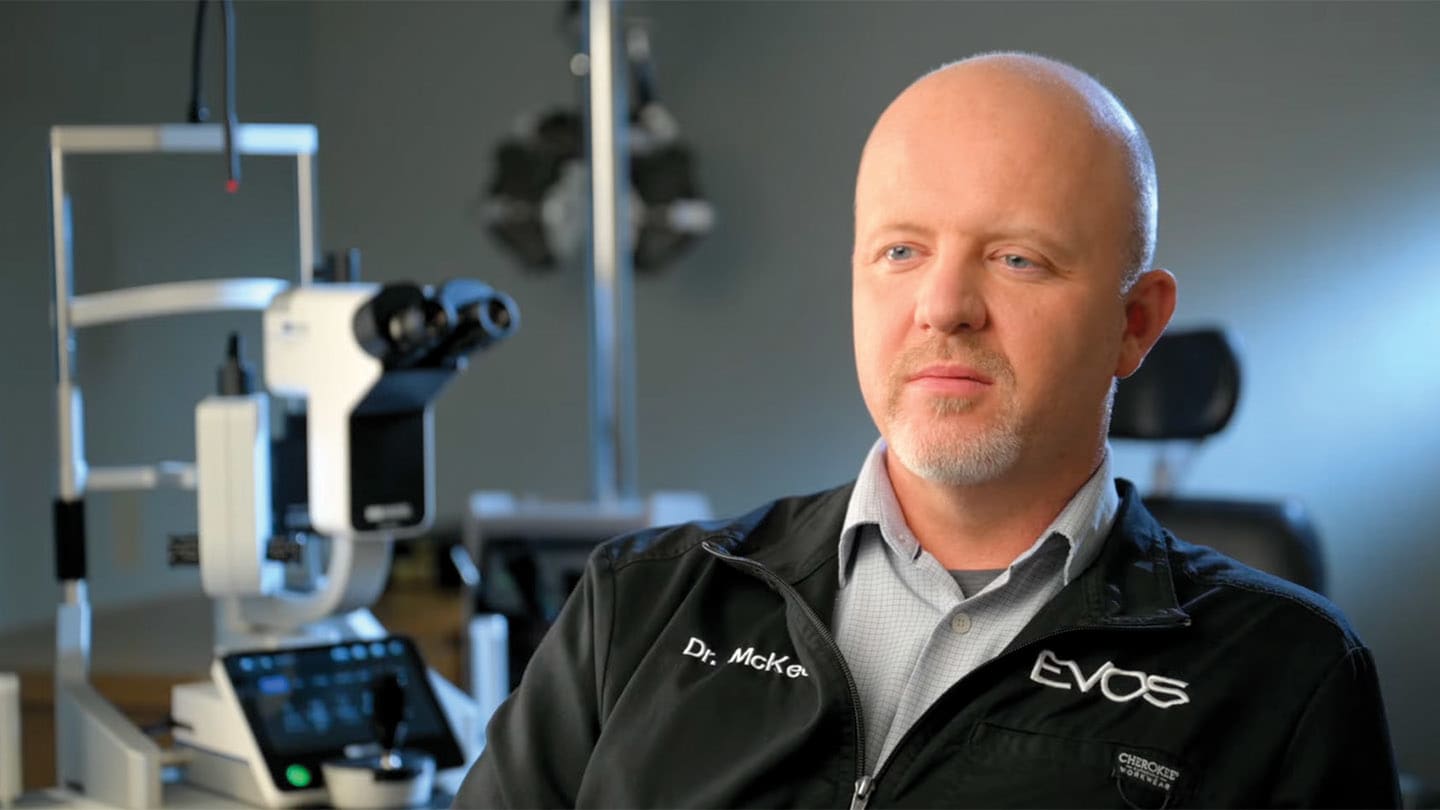
Dr. Yuri McKee, MD, of East Valley Ophthalmology, Arizona is a high-volume anterior segment surgeon specializing in advanced corneal transplant techniques, glaucoma, refractive surgery, and anterior segment reconstruction. In this article, Dr. McKee - Elara 900's first clinical user in the US - shares his firsthand impression of the device - from its revolutionary illumination system to its digital workflow and ergononic design.
Revolutionary projector illumination
One of the most striking innovations of the Elara 900 is its projector-based “P-Type” illumination system. Unlike traditional halogen or LED systems, the projector can emit light across the entire visible spectrum, allowing different colors [and color temperatures for white light] to be selected depending on the pathology being examined.
“This is a very interesting concept,” observes Dr. McKee.
“The entire light source is a projector so you can project numerous colors. It projects a nice, smooth, and even beam, and it’s easy to make [the slit] high, wide, or narrow. Previous slit lamp designs required you to increase width at some point to increase brightness. Here, we can have the narrowest of beams, and with a quick flick of your wrist, you’re increasing the intensity of light as well. This is a completely new concept in slit lamps – a continuous range on a rheostat that’s combined with the slit height and the slit width. With only one hand you’re controlling width, height, and beam intensity through the projector.”
According to Dr. McKee, the projector system delivers other practical advantages: “The advantage of having a projector system for the light is that it’s going to be long-lasting. You’re not going to be changing bulbs. Plus, the entire device is much smaller without the light tower, and there’s now a wide variety of light combinations you can use that were unavailable in previous slit lamp models.”
The result is high-resolution, highcontrast visualization that supports detailed examination of ocular structures.
Infrared imaging
Dr. McKee also highlights the integrated infrared* illumination option of the Elara 900. “This is a great way to look at meibomian glands,” confirms Dr. McKee.
“Previously, you had to buy an expensive device just to image meibomian glands. Now your slit lamp will do it and take pictures of it at the same time.”
High-resolution 3D image & video capture
The Elara 900 integrates dual-camera imaging that enables high-resolution photography and optional 3D** video capture in up to 4K. For documentation, referrals, follow-up, and teaching, this functionality transforms the traditional slit lamp exam into a fully digital experience for users.
“This is an amazing tool for showing patients what’s going on in the eye exam,” exclaims Dr. McKee. “The built-in camera allows you to start taking pictures immediately, and a live video can even be mirrored on screen next to the device so that the patient’s family can see the exam, and you can quickly show the patient the exact degree of their cataract.”
He notes that this real-time visualization fundamentally changes patient communication: “This helps a lot in educating patients why surgery is important, as well as what we’re trying to accomplish in surgery. It means that patients can really be educated about their disease process in a time-sensitive manner that just wasn’t possible before.”
The digital platform “definitely improves our workflow,” adds Dr. McKee, saying: “With practice, you get exponentially faster at your exam.”
Digital “presets” & motorized controls
The Elara 900 introduces digital “presets,” that allow up to six customized exam scenarios. These "presets" combine slit width, height, illumination intensity and color as well as magnification - into a single step.
Dr. McKee says: “Multi-function buttons bring the ‘presets’ exactly where you want them, so you can do your exam much faster. Each physician can also have their own ‘preset’, so when you enter the room, you simply tap on your name and all your ‘presets’ are ready to go for the patient exam. A quick tap on the screen and you find yourself with all the settings automatically adjusted to your liking.”
Continuing, Dr. McKee compares the Elara 900’s innovative integration of several motorized functions, such as motorized magnification changer and motorized height adjustment, in familiar terms: “It’s kind of like the difference between a manual transmission and an automatic transmission,” he says, “as soon as you get used to it, you realize you’re never going back.”
Ergonomics reimagined
As ophthalmologists know all too well, long hours spent at the slit lamp can take a physical toll on a physician. To address this, Elara 900 has been designed from the ground up to promote natural posture and reduce unnecessary strain.
“Elara 900 was built around ergonomics. It was built around making it easy to use, making it fast to use, and giving the surgeon more options than they’ve had in the past,” explains Dr. McKee.
He goes on to emphasize the importance of ergonomics for both physician and patient:
“Ergonomics is becoming increasingly important in slit lamps. We can have neck problems with improper positioning at the optics. It’s also important for patient ergonomics. Most slit lamps in the past did not take into consideration the patient position, and it was always a challenge to get both the patient and the doctor properly aligned. This slit lamp has a headrest that’s actually canted forward. This gives a lot more room for the patient to fit behind the slit lamp and not have to bend over at the waist to put their chin and their forehead properly in the headrest.”
The joystick and touchscreen layout of Elara 900 are equally intuitive: “It’s all ergonomically designed so that one hand can reach the touchscreen while you’re using the joystick,” explains Dr. McKee. “The joystick has at least three different functions, and close to that is a "preset" wheel that allows you to change, for example, the light intensity, slit width or height and different slit lamp modes. So, with two hands never leaving the slit lamp, you’re accessing literally hundreds of different options and combinations of options for how the slit lamp’s going to run.”
A long-term investment
For many surgeons, the slit lamp is a foundational piece of equipment – one that shapes their daily clinical decision-making.
“The majority of eye surgeons have probably used Haag-Streit at least somewhere in their career,” Dr. McKee says, “and I think most doctors will admit that there’s Haag-Streit, and then there’s everyone else when it comes to slit lamps.”
He concludes: “A slit lamp is typically a very long-term purchase. So, people might balk at the idea that they’re going to spend so much on their capital equipment upfront. But if there’s one place you really don’t want to short-change yourself, it’s in the device that you use every day to make every surgical decision.”
*Infrared illumination: availability may vary by region – please contact your Haag-Streit Distributor for details.
**3D license required
To find out more about the Elara 900, please visit Elara 900
