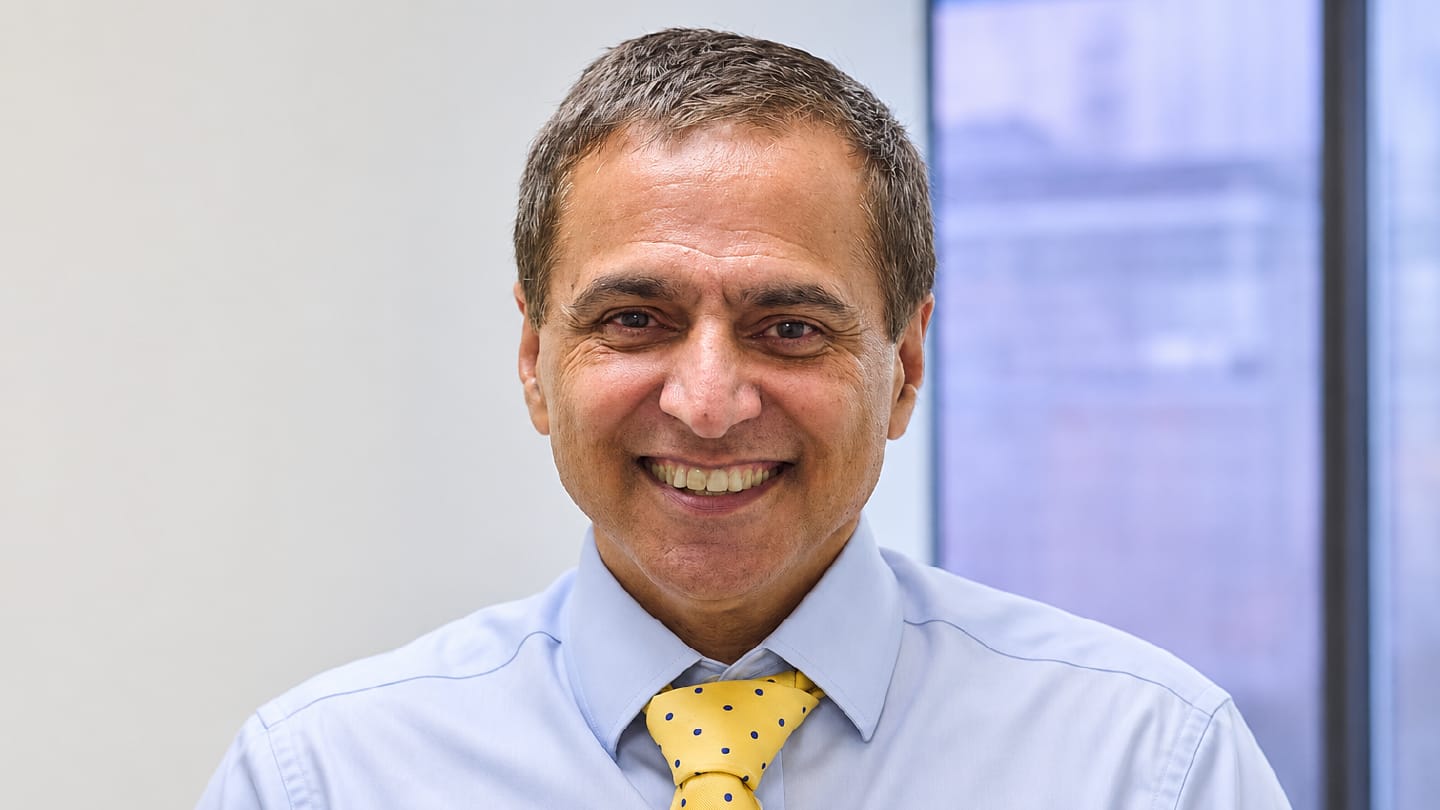
Eye cancer is rare, but its consequences can be profound. At Moorfields Eye Hospital, which treats more than 300 new cases each year, specialists must detect tumours early while avoiding unnecessary referrals – and preserve sight without compromising survival. Consultant ocular oncologist Mr. Amit Arora discusses the difficult decisions involved, and how imaging, artificial intelligence and experimental therapies could change the field.
Ocular cancer is rare, and around a third of cases are asymptomatic. What are the biggest challenges in achieving earlier diagnosis?
Amit Arora: Finding patients as early as possible is probably the hardest part. The disease may cause no symptoms, and we believe about a third of patients are diagnosed by chance. They might have gone to their optometrist or ophthalmologist for something completely different.
There are only four specialist units in the UK, with perhaps a dozen ocular oncologists between us. We want to find cancers early without overwhelming those services with benign lesions.
How do you distinguish an ordinary naevus – a mole in the eye – from a very early melanoma?
My former boss and mentor, John Hungerford, ran the ocular oncology service for Iceland. He told me that, in all the years he worked, he never had to remove an eye, because the tumours were small enough to treat with radiotherapy. He attributed that to screening and regular eye tests. It shows what early detection can mean.
The first step is getting people to see optometrists regularly. From our side, it's about clinical awareness. Professional guidance sets out risk factors and features that should prompt referral. The message isn't to send everything; it's to recognize what needs investigating. Then you need a robust system to get those patients rapidly to a specialist.
Are technology and better communication making a difference?
Amit Arora: Absolutely. When I started as a registrar over 25 years ago, the referral numbers were much smaller. We've seen something like a 300% increase in referrals over the past 15 to 20 years. That doesn't mean there are vastly more tumours. Optometrists increasingly have OCT machines and cameras, so they're picking up abnormalities they wouldn't have seen before.
Unless you've worked in a specialist unit, you might never have had formal training in detecting eye tumours beyond reading a textbook. Ophthalmology has become increasingly specialized. A glaucoma or retinal specialist may see a suspicious lesion and understandably think, “This isn't my field,” and refer it on.
We therefore put a lot of effort into teaching, particularly with medical retina colleagues, who often see referrals from optometrists. We also use the MOLES scoring system, which looks at five characteristics of a lesion – mushroom shape, orange pigment, large size, enlargement and subretinal fluid. Each gets a score from zero to two, and the total helps guide what should happen next.
I recently audited our referrals and found that about one in three didn't have the scoring form completed, despite all the teaching. There's still a way to go.
When treating an intraocular tumour, how do you balance controlling the cancer with preserving the eye and useful vision?
Amit Arora: Whenever I give a lecture, one of my first slides says the goal of treatment is to save your life, then your eyeball, then your eyesight. Vision is enormously important, but the priority is to treat the tumour adequately. Sometimes we may lose vision, and sometimes we may have to remove the eye. You cannot undertreat a cancer and risk somebody's life in order to preserve sight.
But I always say: you treat the patient, not the eye. Decisions are made together. Some patients absolutely refuse to have an eye removed, even when we think that's clinically the best option. Others might be suitable for radiotherapy but have medical problems, find travelling to London difficult, or simply do not want repeated treatments and follow-ups. They may say, “I'd rather you take the eye out. One operation and it's done.” We have to take all of that into account.
What determines whether someone receives plaque radiotherapy, proton beam therapy or enucleation?
Amit Arora: London has used plaque radiotherapy for almost a century. The key considerations are tumour size, location and other complicating factors.
A plaque is a small radioactive disc placed against the surface of the eye to cover the tumour inside. Plaques come in different sizes, so there are limits to the tumour width and thickness we can treat successfully. If the tumour is beyond those limits, proton beam radiotherapy may be an option. It's highly targeted, and it can treat larger tumours. Patients travel to Clatterbridge, near Liverpool, for proton treatment, then return to their specialist unit for follow-up.
Both forms of radiotherapy can damage vision. If a tumour is away from the macula and optic nerve, we hope the visual outcome will be better, but we warn everybody about the risks.
Then there are patients with very large tumours, extensive retinal detachment, or an eye that already has no useful vision. Radiotherapy may have a lower likelihood of success, and the patient could develop secondary glaucoma and end up with a painful, blind eye. I wouldn't wish that on anybody. We may recommend enucleation from the outset.
Radiotherapy doesn't work overnight, either. It may take six to nine months before we can judge whether the tumour is responding. If treatment fails, that's valuable time lost with a potentially active cancer. You have to weigh the risks carefully. Patients' first fear is often, “Am I going to go blind?” I explain that our priority is to keep the rest of them safe, and then do the best we can for their vision.
How important is the multidisciplinary team, particularly when there is a risk of metastatic spread?
Amit Arora: It's extremely important. When I started, we didn't really have MDTs in the way we do now. John Hungerford was pretty much the only ocular oncologist in London, and he used to joke that it was difficult to have a multidisciplinary discussion when he was the one making the decisions anyway.
Now we meet every Wednesday. The surgeons, fellows, radiation physicists, pathology colleagues, specialist nurses and coordinators all contribute. We also have clinicians joining from elsewhere in the country to discuss their patients. For patients at risk of metastatic disease, we work closely with medical oncologists involved in their screening and care.
The MDT gives patients something else that's very important: time. Being told you have cancer in your eye is life-changing. They may initially say, “Absolutely not, I'm not having my eye removed.” We give them information to take home, they talk to family and friends, and we discuss their case as a team. A week later, we can come back with a collective recommendation rather than just one doctor's view.
Often patients have had time to digest the diagnosis and feel more able to make a decision. It also gives us another chance to review their case. That makes a real difference.
How has patient counselling and support changed during your career?
Amit Arora: A lot of medicine comes down to managing expectations. Even if I remove the eye and tumour, I can't promise someone a complete cure; there may still be a risk of the cancer spreading. Patients need to understand that, however difficult it is to hear.
We have more support than we used to. In the early days, we had one clinical nurse specialist; now we have two full-time and one part-time. Patients can also turn to charities and support organizations such as Macmillan, OcuMel UK and Maggie's, and we have counselors at Moorfields.
But we're a national service, so patients may live a long way from London. The challenge is what happens when they're back at home: how easy is it for them to get psychological support locally? That can still be difficult. Then there's the information they find online. Every week someone says, 'I looked it up, and Google told me this.' We need to help them interpret it in the context of their diagnosis.
Which advances in ocular oncology are you most excited about?
Amit Arora: AI is certainly a promising step forward. We're working on a project looking at those small lesions where it's difficult to judge whether they're benign or malignant. Can we feed in OCT scans, ultrasound images and photographs, and use AI to give an indication of the likelihood of malignancy?
If it works, an optometrist or local ophthalmologist might be able to identify which patients really need specialist referral and which can be monitored. We're involved in other AI projects too. The aim is more reliable early decisions.
In metastatic disease, we're improving year-on-year, although we still don't have the cure we'd like. Twenty or thirty years ago there was effectively no treatment. There was even an argument about whether you should screen patients for metastases if you had nothing to offer them. Now we have treatments such as tebentafusp, which can give some patients more time. It may not be curative, but perhaps the second or third generation of these treatments will take us closer to that goal.
At Moorfields, we've also just completed work on a laser-based treatment for small tumours that activates the immune system. The details remain under embargo, so I can't say much yet, but it may offer a way of treating some small tumours without radiotherapy.
We've also started enrolling patients in a trial of darovasertib, a drug that has shown tumour shrinkage in early studies. The hope is that you might shrink a large tumour enough to treat it with radiotherapy instead of removing the eye. With smaller tumours, reducing the volume might mean you can give less radiation and potentially preserve more vision. So the drug might save eyes and, hopefully, some eyesight too.
My colleague Professor Mandeep Sagoo leads much of our research, and new ideas are always coming forward. The difficulty is that many of these developments may take five or 10 years to come to clinical use. I may be retired by then, but we're working hard towards them.
And one thing I want to stress is that this is never just about me or any individual in our service. We share our patients. It doesn't matter whose name is on the referral; we'll see them as quickly as we can, and whichever colleague is available will take care of them. From the doctors and nurses to the administrative staff, counselors and coordinators, we work as one team. Everybody deserves recognition for that.