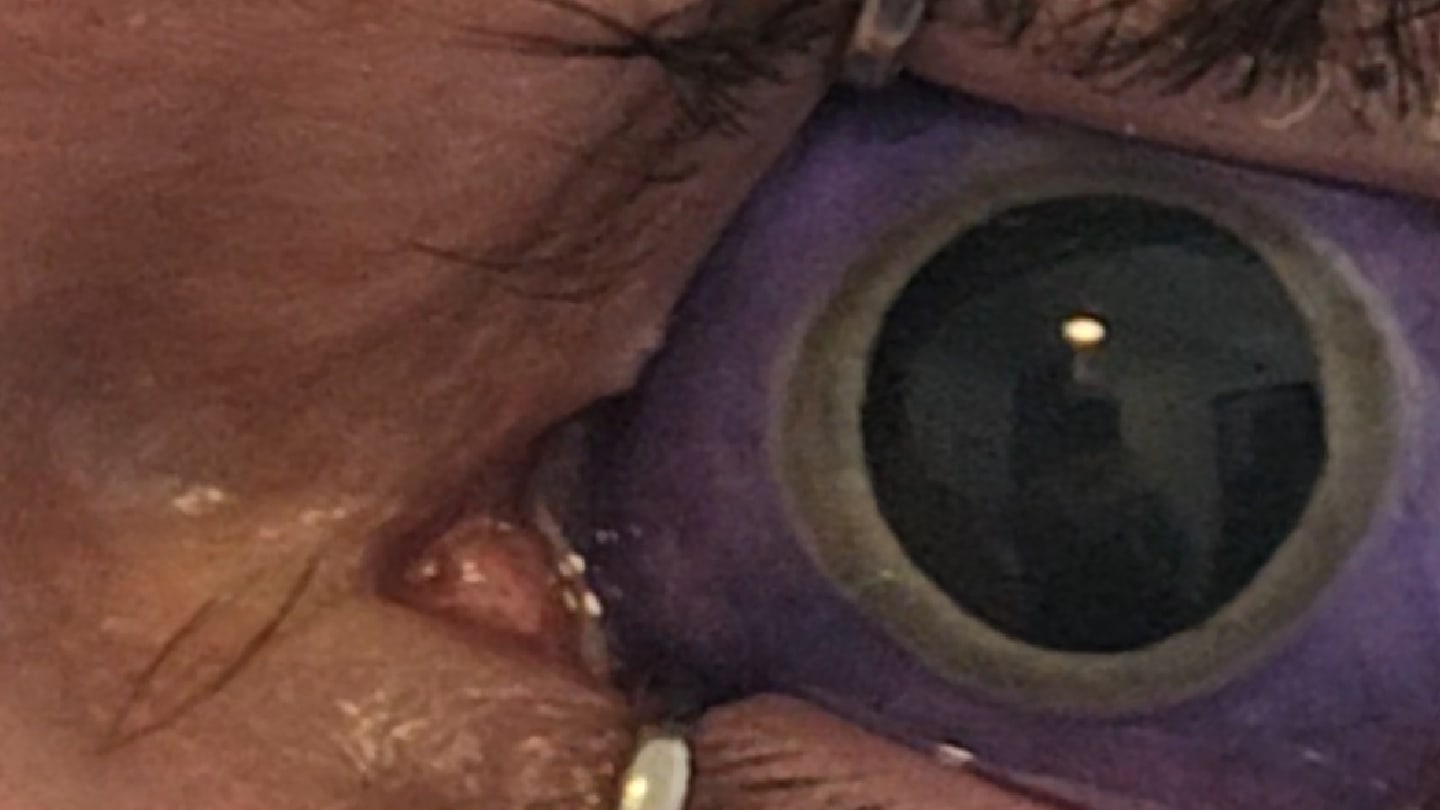
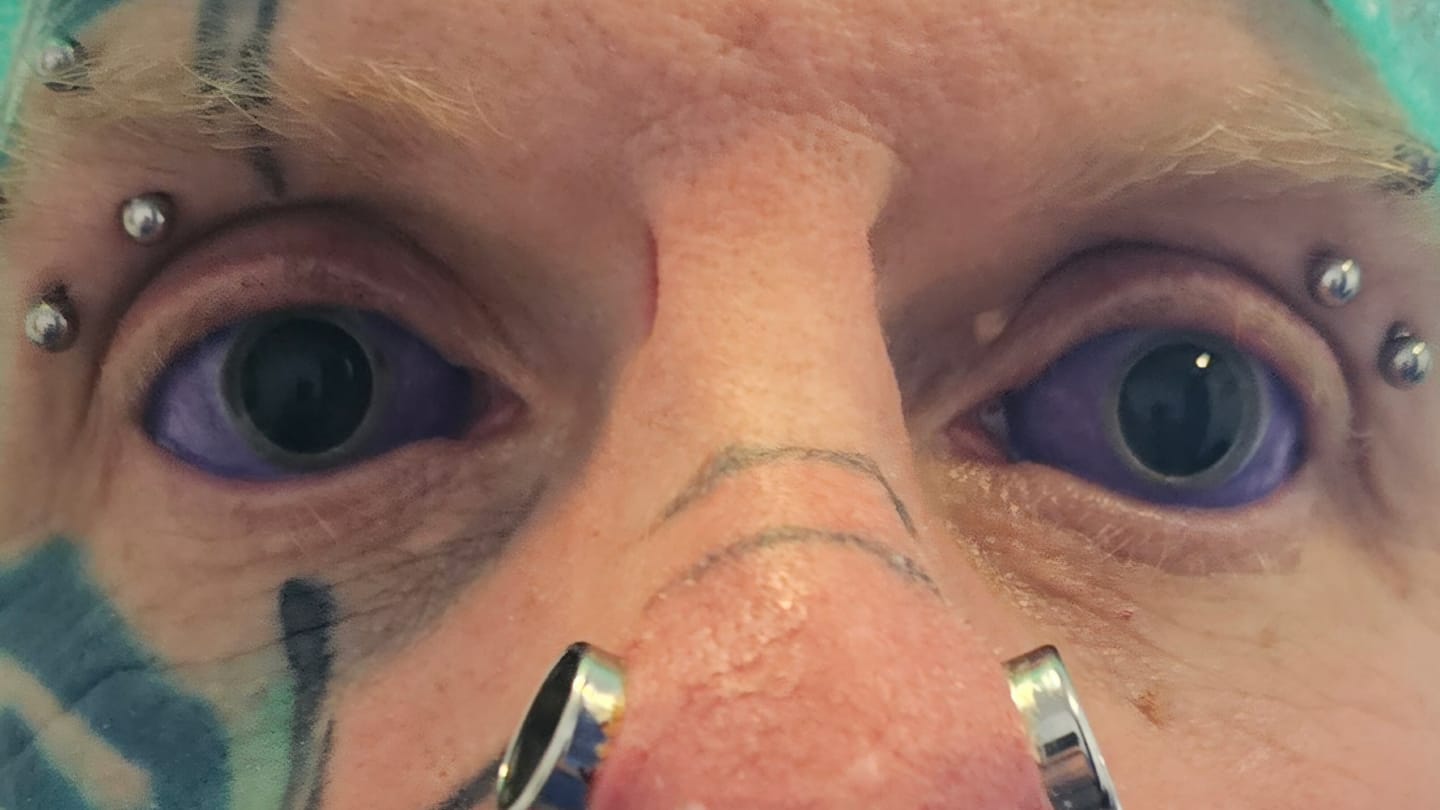
They do everything together. Seven years ago they even had their sclerae tattooed together – matching violet. Then this July they came to Leipzig together, a married couple, for refractive lens exchange in all four eyes. And when I asked after their surgery whether I could write about them, they answered together: with a folder of photographs and written consent to use their images and complete records.
She is 53, a trained office administrator. He is 50, a qualified electrical engineer who spends his working days testing semiconductors. If the phrase “eyeball tattoo” conjures up recklessness, revise that thought: I have rarely met patients who documented their own medical history so extensively.

Where the violet comes from
Scleral tattooing – eyeball tattooing, in the language of the people who have it done – is barely 20 years old. The first three were performed in 2007 by a body-modification artist working under the name Luna Cobra; one of the original volunteers reportedly wanted the blue eyes of the Fremen in Frank Herbert’s Dune. Ink is injected under the bulbar conjunctiva and allowed to spread. There is no design and no line work, and there is no removing it afterward. The practice is banned in several US states and in Ontario; in Germany it sits in a legal gray zone, and the forensic literature has asked whether a resulting loss of vision would meet the threshold for grievous bodily harm under §226 StGB.
This couple can tell you exactly how theirs was done, which is itself unusual. Their artist – a South American body-modification specialist – consulted ophthalmologists before developing his method, and sent them home with antibiotic drops. He injected no more than 0.6 ml of ink per eye, through two punctures, thinned slightly for viscosity. Their violet is one of the more demanding colors – it contains white and red pigments, which by the community’s own experience heal more slowly and can be light-sensitive; plain black behaves best. When the drops irritated their eyes they stopped using them, sensibly, and rinsed with saline several times a day instead. The swelling settled within days. What lingered, they told me, was a period of dry eye “not unlike the dryness after the lens surgery.” Seven years on, that comparison is theirs – and it is a fair one.
What the literature shows
Their seamless experience does not belong to everyone. In the most-cited review, of fourteen reported cases, ten (71%) involved inadvertent penetration of the globe, and those patients had the worst visual outcomes. The catalog of published sequelae is long: subconjunctival hemorrhage, chronic chemosis, corneal dellen, granulomas, anterior uveitis, scleritis, orbital cellulitis, secondary glaucoma, traumatic cataract, retinal breaks and detachment, scleral melt, endophthalmitis, phthisis. A Canadian series described a young man enucleated two months after an attempted scleral tattoo led to endophthalmitis; histology showed pigment staining the inner retina, the sclera and the corneal endothelium.
Others do far better. A 2025 case in Cornea described a young woman with bilateral scleral tattoos whose subconjunctival granulomas were excised with the black pigmentation deliberately preserved, out of respect for what she had chosen; she was 20/20 in both eyes at a year. That instinct – treat the disease, keep the person – is the right one.
Operating on tattooed eyes
What the literature does not prepare you for is the ordinary business of surgery on eyes like these, and here this couple taught me two lessons at once.
The first is what the pigment does not touch. In both of them the ink sat exactly where their artist said it would: in the subconjunctival space, clear of the limbus and nowhere near the visual axis. Biometry was unremarkable. Corneal assessment, anterior chamber measurements, macular thickness, dilated fundus examination – all unimpeded. Both underwent uneventful bilateral clear lens extraction with excellent refractive results, and their post-operative course was as smooth as any on that list.
The second is what the pigment silences. Conjunctival injection is one of the first signs we look for and one of the first you give up: you cannot see redness through violet. Post-operative inflammation has to be judged on symptoms, pressure and the anterior chamber. Scleral thinning is hidden, and so is anything the conjunctiva might one day try to tell us – pigmented conjunctival lesions are precisely the kind of thing we like to watch. Follow-up shifts onto the patient’s own reporting. Mine reported like engineers – which one of them is.
The people in the chair
I want to dwell on this couple, because they changed how I think about the issue.
They knew the volume of ink in their own eyes to the decimal. They knew why they had stopped the antibiotic drops and could describe the reaction that made them do it. They authorized me, in writing, to use not only their photographs but their complete records and every examination result. When I mentioned that daylight images would show the sclerae better than pictures taken the morning after surgery, they offered to drive 200 km to be photographed – and then simply sent a folder of professional portraits instead, with a note saying they would love a printed copy of the article when it appears. They even put me in touch with their artist, who by their account is delighted that an ophthalmologist wants to understand his work rather than merely condemn it.
People who modify themselves this visibly are used to being looked at, and often unkindly. It is worth remembering that they walk into our clinics carrying that experience. This couple were open, precise and genuinely easy to care for, and they wanted what every other refractive patient wants: to see well.
The artist’s answer
Their artist, for his part, rejects the charge most often laid against the practice – that a tattooed eye can no longer be properly examined. Done precisely, he argues, the pigment stays in the subconjunctival space and neither displaces nor obscures the inner structures of the globe; the disasters come from deficient technique and ignorance of anatomy, not from the idea itself. Seven years of follow-up in this couple largely supports him: every intraocular examination we needed, we got. But “largely” is doing real work in that sentence. The ocular surface remains silenced, the practice remains unregulated, and the published cases suggest that not everyone holding the syringe works to his standard. Precision is not a property of the idea; it is a property of the hands.
The other ink
Here is what makes this subject genuinely interesting rather than merely alarming: putting pigment into an eye is one of the oldest procedures in our specialty. Galen is credited with the first attempt, using reduced copper sulphate to mask a corneal leukoma. Ziegler formalized the modern technique in 1922. Today we call it keratopigmentation – a legitimate reconstructive operation for disfiguring corneal scars and for the glare and diplopia of iris defects, performed superficially or intrastromally, by hand or through femtosecond-created tunnels, with micronized mineral pigments. In the largest published series, of 234 eyes, complications occurred in 12.8%, most commonly light sensitivity. Same instinct. Same color in the same eye. One performed in a studio, one under a microscope.
Where the line sits
Which brings me to the part that concerns us rather than them.
Cosmetic keratopigmentation – corneal tattooing purely to change the apparent color of a healthy, sighted eye – is now offered commercially in the United States, Spain, and France, on small series and short follow-up. A German case published last year illustrates the difficulty: a man who had the cornea of a blind eye blackened abroad presented years later asking about transplantation, and the pigment sat so densely in the deep stroma that neither the posterior cornea nor the fundus could be assessed through it; his retina had to be evaluated by ultrasound. That is a permanent diagnostic obstacle created in a clinic, by a colleague, with a consent form on file. Unlike my patients’ subconjunctival violet, corneal pigment sits in the window itself. If we are uneasy about what tattooists do to the sclera, we should hold ourselves to at least the same standard when the needle is ours.
This couple made an informed choice about their own bodies and have lived with it well, in the hands of an artist who at least conferred with ophthalmologists first. I would operate on either of them again tomorrow. But their eyes crystallized something I now think about before any irreversible pigment goes near a healthy eye: whatever we put in, the next clinician has to see past.
References
- A Rohl et al., "Two cases of pen ink scleral tattoos and a brief review of the literature," Am J Ophthalmol Case Rep., 21:101015 (2021). PMID: 33537509.
- W Chan et al., "Complications of ocular tattooing: a Canadian case series," Can J Ophthalmol., 54:e273 (2019). PMID: 31836111.
- G Ortiz-Morales et al., "Scleral tattooing complications: surgical management of granulomas in a cosmetic procedure," Cornea, 44, 1049 (2025). PMID: 39836606.
- JL Alió et al., "Keratopigmentation with micronised mineral pigments: complications and outcomes in a series of 234 eyes," Br J Ophthalmol., 102, 742 (2018). PMID: 28855194.
- L Kröger et al., "Hornhaut-Tattoo bei kosmetischer Einschränkung," Die Ophthalmologie, 121, 320 (2024).
- F Ramsthaler et al., "Augapfeltätowierungen oder ,eyeball tattoos,'" Rechtsmedizin, 32, 362, (2022).
